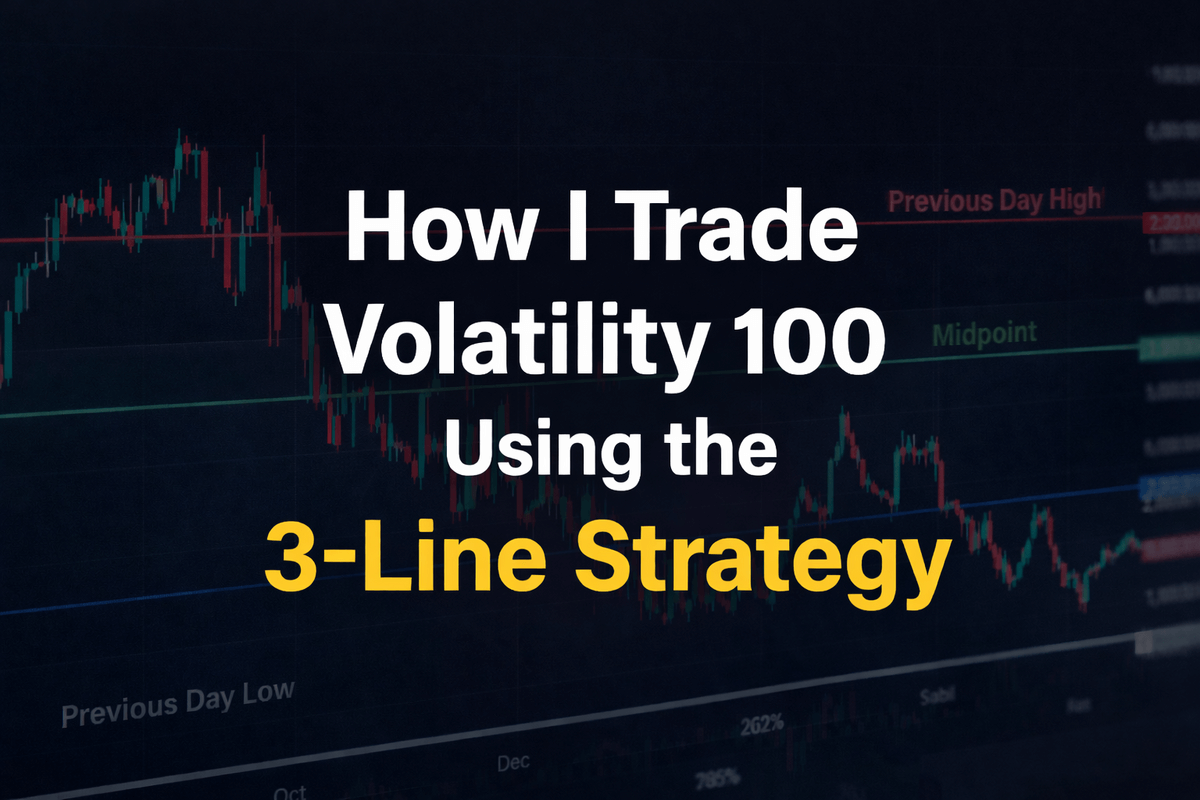
If you’ve traded Volatility 100 for any length of time, you already know the truth: this market doesn’t forgive impatience. Volatility 100 moves all day, every day. That’s what attracts people to it. It’s also why many traders lose money quickly—too many trades, too much guessing, not enough structure. After going through indicators, signals, and different “systems,” I ended up doing the opposite. I simplified everything. Today, I trade Volatility 100 using just three lines. And it’s enough.
Learn the Secret of Forex Trading, Click here to download a free e-book now
Why I Keep It Simple on Volatility 100
Volatility 100 isn’t driven by news or economic events. There’s no CPI, no interest-rate announcement, no surprise headline. Price reacts to levels.
Most losses happen when traders:
- Enter without a clear area
- Trade in the middle of price
- Chase moves after big candles
- Feel pressured to be in a trade
I used to do the same. The moment things changed was when I stopped asking “Where is price going?” and started asking “Where is price reacting?”
The 3-Line Strategy Explained
At the start of every trading day, I draw only three levels on Volatility 100:
- Yesterday’s High
- Yesterday’s Low
- The midpoint between them
That’s the entire setup. Those three lines guide every decision I make for the day.
How I Set It Up Each Day
I switch my chart to Daily (24h) and look at the previous day.
- I mark the highest point
- I mark the lowest point
- I draw the midpoint
If you want to practice how to trade properly, start with a free Deriv demo account
Once that’s done, I don’t adjust the levels again.
I let price come to me.
How I Actually Trade the Levels
Here’s the key thing:
I don’t trade levels. I trade reactions.
When Price Reaches Yesterday’s High
If Volatility 100 moves into the previous day’s high, I don’t rush to sell.
I wait.
I want to see:
- Rejection wicks
- A strong bearish candle
- Price failing to stay above the level
Once the market shows me that buyers are struggling, I look for a sell.
When Price Reaches Yesterday’s Low
Same idea, opposite side.
When price reaches yesterday’s low, I don’t buy immediately.
I wait for:
- Rejection to the downside
- Strong bullish closes
- Signs that selling pressure is fading
Only then do I consider a buy.
The Midpoint Rule (This Saves Accounts)
If price is around the midpoint, I do nothing.
No buying.
No selling.
No “maybe.”
The midpoint is where emotions take over and accounts slowly bleed.
Waiting is part of the strategy.
Timeframes I Use
- Daily (24h): draw the levels
- 15m–1h: understand the move
- 5m–15m: execute the trade
This works whether you’re new to Volatility 100 or you’ve been trading it for years.
Risk Management
I keep this simple too:
- Fixed lot size
- Stop loss beyond the rejection
- Profits taken logically, often toward the midpoint
The goal isn’t to win every trade.
It’s to stay consistent and disciplined.
Why This Works on Volatility 100
Volatility 100 respects structure more than indicators.
Previous day highs and lows act like magnets.
Price tests them, reacts, and moves.
When you stop forcing trades and start waiting for price to show its hand, trading becomes calmer—and more controlled.
Final Thoughts
If Volatility 100 has been stressful for you, try doing less, not more.
Draw three lines.
Wait for price.
Trade the reaction.
That’s how I trade Volatility 100 using the 3-Line Strategy.
Risk Disclaimer
Deriv offers complex derivatives, such as options and contracts for difference (“CFDs”). These products may not be suitable for all clients, and trading them puts you at risk. Please make sure that you understand the following risks before trading Deriv products: a) you may lose some or all of the money you invest in the trade, b) if your trade involves currency conversion, exchange rates will affect your profit and loss. You should never trade with borrowed money or with money that you cannot afford to lose.