One of the biggest decisions in synthetic trading is choosing an instrument that matches your trading strategy. Some traders are more comfortable buying into an upward market, while others prefer selling when prices are moving down. PainX and GainX offer both opportunities, but understanding their behaviour is what separates a calculated trade from a risky guess.
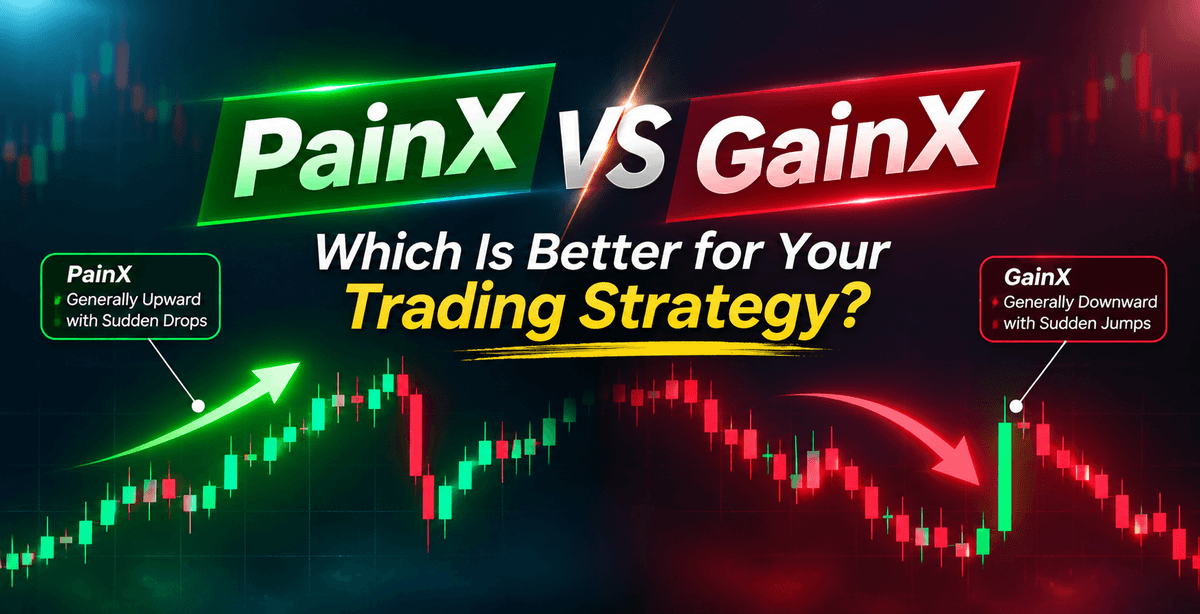
PainX is known for its general upward price movement, interrupted by occasional sharp downward drops. GainX moves in the opposite direction, generally trending downward with occasional sharp upward jumps.
This creates an interesting choice for traders. PainX attracts those looking for BUY opportunities, while GainX often appeals to traders who prefer SELL positions. Both can offer opportunities, but both also have a catch: the sudden opposite-direction movements can wipe out profits surprisingly quickly when positions are poorly managed.
So, should you focus on PainX or GainX? Is one easier to trade? Which offers better opportunities for your preferred strategy, and how can you protect your account when the unexpected happens?
Let’s compare the two instruments, examine their price behaviour and explore the strategies that can help you trade them more intelligently.
Understanding How PainX Works
PainX is a synthetic trading instrument from Weltrade’s SyntX offering. Its general price behaviour is upward, but that does not mean it rises continuously.
The price can experience periods of upward movement before a sudden downward drop interrupts the trend. These drops are an important part of understanding PainX because they can catch traders who enter BUY positions without considering the risk.
For traders who prefer buying, the general upward movement provides a directional framework. Rather than buying at every green candle, a more disciplined approach is to identify pullbacks, locate areas where buyers may return and wait for confirmation before entering.
What should you look for when trading PainX?
- Higher highs and higher lows, indicating an upward market structure.
- Pullbacks towards support or demand zones.
- Bullish rejection candles around important price levels.
- Breakouts above previous resistance, followed by a successful retest.
- A clear stop-loss level that accounts for the possibility of a sudden downward drop.
The objective is to find a favourable BUY entry without assuming that the upward movement will continue uninterrupted.
Understanding How GainX Works
GainX presents a different trading environment. Its general price progression is downward, with occasional sharp upward jumps.
This downward tendency makes GainX particularly interesting to traders who prefer SELL positions. They look for opportunities to enter during a pullback and benefit when the downward movement resumes.
However, the upward jumps deserve serious attention. A trader can make several successful SELL trades and still lose a significant amount if an unexpected jump catches an oversized or poorly protected position.
The Next Move Could Be Your Opportunity.
Study the market. Build your strategy. Explore PainX and GainX with Weltrade.
What should you look for when trading GainX?
- Lower highs and lower lows, indicating a downward market structure.
- Pullbacks towards resistance or supply zones.
- Bearish rejection candles around areas where sellers may return.
- Breaks below previous support levels, followed by a retest.
- A stop-loss and position size that take sudden upward jumps into account.
The goal is not to sell simply because GainX is moving down. It is to identify a good location, wait for confirmation and manage the position carefully.
PainX vs GainX: What Is the Difference?
The main difference is their general price direction and the type of sudden movement that can interrupt it.
| Feature | PainX | GainX |
|---|---|---|
| General price direction | Upward | Downward |
| Sudden movement | Sharp downward drop | Sharp upward jump |
| Common directional approach | BUY | SELL |
| Useful areas to study | Support and demand | Resistance and supply |
| Main risk to directional traders | Sudden downward movement | Sudden upward movement |
| Common market structure | Higher highs and higher lows | Lower highs and lower lows |
These characteristics provide a starting point for analysis, not a guarantee of what price will do next. Both instruments can move against an open position, and traders should never assume that the next sudden movement is predictable.
Which Is Better for BUY Trading?
If your preferred strategy involves buying pullbacks, identifying demand zones and trading bullish market structure, PainX may be the more natural choice.
Its general upward progression gives BUY traders a directional framework. You can study previous highs and lows, identify areas where price has found support and wait for evidence that buyers are returning.
For example, suppose PainX is making higher highs and higher lows. Price then pulls back towards a previous support area. Instead of entering immediately, you wait for a bullish rejection candle or a break of a minor resistance level.
That confirmation may provide a more structured entry opportunity.
However, do not overlook the sudden downward drops. A BUY position without a sensible stop-loss or appropriate position size can expose your account to substantial losses.
Which Is Better for SELL Trading?
For traders who prefer selling, GainX may be the more natural choice.
Its general downward progression allows traders to look for lower highs, lower lows and pullbacks towards resistance. The idea is to enter when the price shows signs of continuing its downward movement.
Consider a situation where GainX is forming lower highs and lower lows. Price retraces towards a previous supply zone and begins showing bearish rejection. A trader may then look for a SELL opportunity, with a clearly defined invalidation level.
The challenge is managing the sudden upward jumps. A trader should not mistake a general downward tendency for protection against an upward spike.
A good SELL setup still needs a clear exit plan.
Can You BUY GainX or SELL PainX?
Yes. Traders can take either BUY or SELL positions on both instruments, depending on their analysis and trading strategy.
However, there is an important distinction between trading with the general direction and trading against it.
Buying GainX: This means taking a BUY position against its general downward progression. A trader may be looking to capture an upward retracement or a sudden upward jump. The difficulty is identifying how far that upward movement may travel and when it may end.
Selling PainX: This means taking a SELL position against its general upward progression. A trader may be attempting to benefit from a downward retracement or sudden drop. However, the price may resume its upward movement and move against the position.
Counter-directional trades are not automatically wrong, but they require a clear reason for entering and a disciplined exit plan. They should not be treated as easy opportunities simply because an opposite-direction movement is possible.
For traders who are still developing their approach, studying BUY setups on PainX and SELL setups on GainX may provide a more straightforward starting point.
Three Technical Approaches to Finding Better Entries
Understanding the general behaviour of PainX and GainX is only the beginning. You still need a method for deciding when to enter and when to stay out.
Here are three practical areas to include in your analysis.
1. Market Structure: Identify the Direction
Market structure helps you understand whether price is generally moving upward or downward.
On PainX, look for higher highs and higher lows. These suggest that buyers are maintaining control of the broader movement.
On GainX, look for lower highs and lower lows. These suggest that sellers are maintaining control.
You can also watch for a break of structure or a change of character (CHoCH). These may indicate that the existing movement is weakening or that the market is beginning to behave differently.
Do not enter simply because a structure has been identified. Use it to establish direction, then look for a suitable entry location.
2. Support, Resistance and Points of Interest
A good entry location can make a significant difference to the quality of a trade.
For PainX, study previous support areas, demand zones and bullish order blocks. These may provide locations where buyers could become active again.
For GainX, study previous resistance areas, supply zones and bearish order blocks. These may provide locations where sellers could return.
A point of interest (POI) is not an automatic entry signal. Price can break through a zone, so wait for evidence of rejection or a change in short-term market structure before committing to a trade.
3. Candlestick Confirmation
Candlestick patterns can help you assess how price is reacting around important levels.
For PainX, bullish engulfing candles and bullish rejection wicks may support a BUY setup around demand or support.
For GainX, bearish engulfing candles and bearish rejection wicks may support a SELL setup around supply or resistance.
The location matters. A bullish engulfing candle in the middle of an extended move is not necessarily a strong BUY signal. Similarly, a bearish candle without a meaningful resistance level behind it may offer little reason to enter.
Combine candlestick confirmation with market structure and a well-defined point of interest.
The Risk That Every PainX and GainX Trader Must Understand
The most important lesson when trading these instruments is that their general direction does not remove the risk of sudden price movements.
On PainX, a sharp downward drop can quickly affect a BUY position. On GainX, a sudden upward jump can have the same effect on a SELL position.
This is why risk management should be part of your strategy before you enter a trade.
Consider these principles:
- Choose your position size carefully. Do not risk an amount that would seriously affect your trading capital if the trade fails.
- Define your exit before entering. Know where your trade idea becomes invalid.
- Avoid excessive leverage. A relatively small price movement can have a large effect on a highly leveraged position.
- Do not chase losses. Increasing your position after an adverse move can make an already difficult situation worse.
- Do not assume a spike is overdue. The instrument’s general behaviour does not tell you exactly when its next sudden movement will happen.
- Understand stop-loss execution. During sharp price movements, an order may be filled at a different price from the one requested.
A strategy that produces several small wins but exposes the account to one uncontrolled loss is not a sound strategy. Your aim should be to manage risk across a series of trades, not simply to win the next one.
What About the Different PainX and GainX Variants?
Weltrade offers different variants of PainX and GainX, including versions identified by numbers such as 400, 600, 800, 999 and 1200.
These numbers relate to the designed tick intervals associated with the instruments’ occasional drops or jumps. They should not be interpreted as minutes, candle periods or guaranteed countdowns to the next sudden movement.
If you are comparing variants, study their individual price behaviour rather than assuming that a strategy tested on one will perform in exactly the same way on another.
It is also worth practising on a demo account before committing real money. This gives you an opportunity to observe price behaviour, test your entry rules and understand how your risk controls respond.
Final Thoughts: Should You Trade PainX or GainX?
PainX and GainX can both offer opportunities, but they appeal to different trading preferences.
If you prefer BUY setups, bullish market structure and trading from demand zones, PainX may be the better fit for your approach.
If you are more comfortable with SELL setups, bearish market structure and trading from supply zones, GainX may be more suitable.
But do not choose based on direction alone. The sudden downward drops on PainX and upward jumps on GainX are central to their risk profiles. You need to understand these movements and build your risk controls around them.
My recommendation is simple: choose one instrument, study its behaviour, develop a clear entry and exit strategy, and test that strategy before increasing your exposure. Once you can explain why you are entering a trade, where your idea becomes invalid and how much you stand to lose, you are approaching the market with a much stronger foundation.
The best instrument is not necessarily the one that moves in your preferred direction. It is the one you understand well enough to trade with discipline.
Trading synthetic indices involves substantial risk and may not be suitable for every trader. You can lose your invested capital. Understand the instruments and practise with a demo account before trading with real money.
Frequently Asked Questions
1. What is the main difference between PainX and GainX?
PainX generally moves upward with occasional sharp downward drops, while GainX generally moves downward with occasional sharp upward jumps.
2. Is PainX better than GainX?
Neither is universally better. PainX may suit traders who prefer bullish BUY setups, while GainX may suit traders who prefer bearish SELL setups. Your trading strategy and risk tolerance should guide your choice.
3. Is GainX suitable for SELL trading?
GainX’s general downward progression makes SELL trading a natural directional approach. However, sudden upward jumps can cause substantial losses on poorly managed SELL positions.
4. Can I BUY GainX?
Yes. You can take a BUY position on GainX, but this is against its general downward behaviour. It requires careful timing and risk management.
5. Can I SELL PainX?
Yes. You can SELL PainX, but this is against its general upward behaviour. The price may continue rising against your position.
6. Which is riskier, PainX or GainX?
Both carry significant risk. PainX can experience sudden downward drops, while GainX can experience sudden upward jumps. The impact on your account depends on factors such as position size, leverage and risk management.
7. Do PainX and GainX spikes happen at fixed times?
No. The tick intervals associated with the instrument variants should not be treated as an exact countdown. Traders should not assume that a sudden movement is due simply because a certain number of ticks has passed.