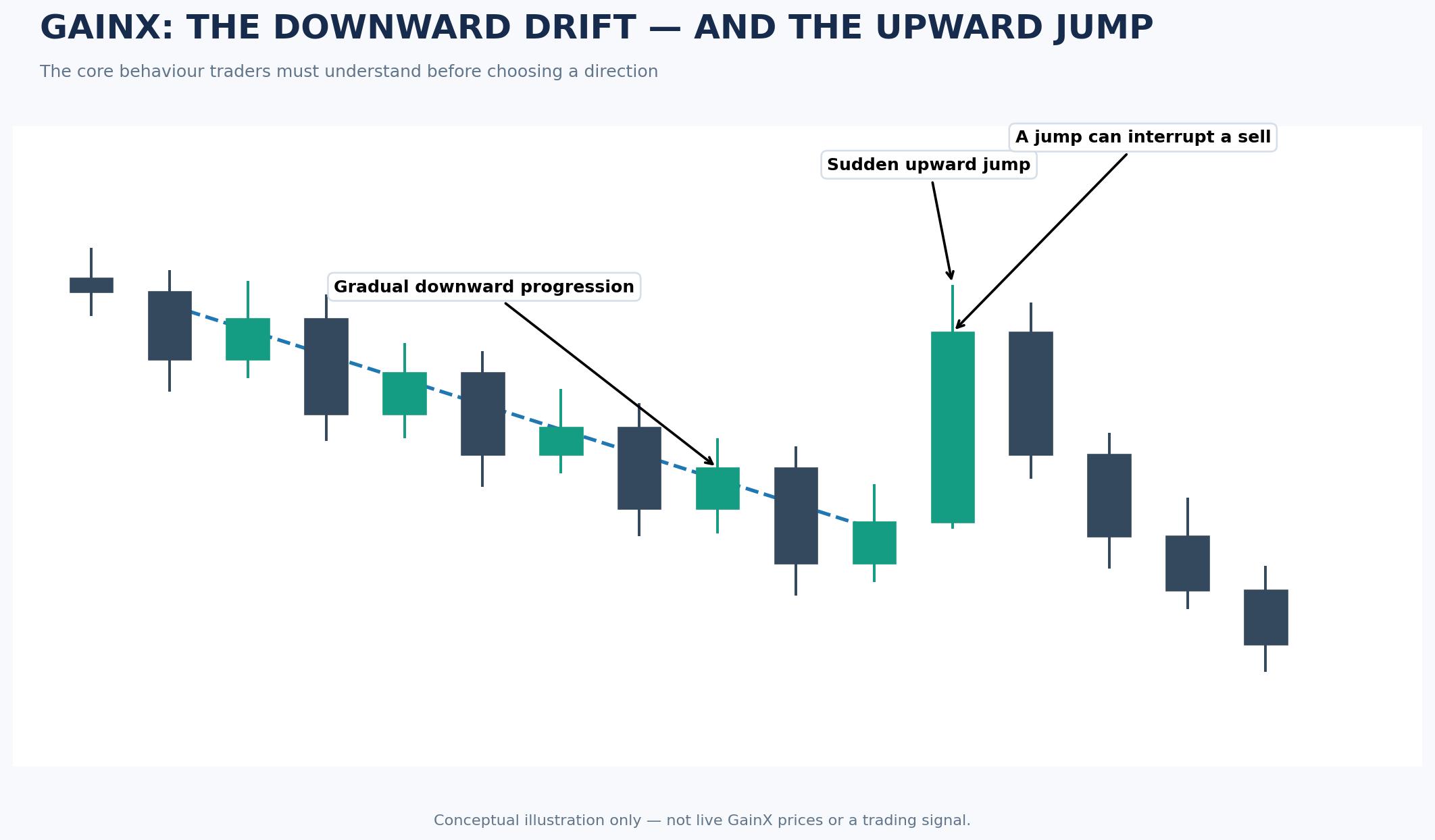
If you have traded synthetic indices for some time, you probably understand why GainX attracts so much attention. Its downward price progression creates opportunities for traders who know how to identify selling positions, capture price movements and manage their exits.
Every Spike Is an Opportunity. Every Move Requires a Strategy.
Explore GainX and discover a new way to experience synthetic trading with Weltrade.
But there is another side to GainX that every trader must understand: the sudden upward jump.
This is where many traders get caught.
A trader may open a SELL position, watch the market move in their favour, close several profitable trades and gradually become confident. Then an unexpected upward jump occurs, turning what looked like an easy trading opportunity into a substantial loss.
That is the reality of GainX.
The instrument offers opportunities in both directions. However, its natural downward price behaviour explains why many traders favour SELL positions. The challenge is learning when to enter, when to take profit and, most importantly, how to protect your account when the market jumps against you.
In this guide, we explore how to trade GainX, identify potential selling opportunities, understand its upward jumps, use technical analysis and develop a more disciplined trading approach.
1. Understanding GainX: Why Traders Prefer Selling
GainX is one of the synthetic indices available on Weltrade’s SyntX platform.
Its defining characteristic is a downward price progression interrupted by occasional sharp upward jumps.
Think of it this way:
- The normal price progression creates opportunities for sellers.
- An upward jump creates a sudden move against sellers.
- Traders can also take BUY positions, but these are generally counter-directional to the instrument’s usual progression.
This creates two different trading opportunities, each with its own risks.
Why SELL positions attract traders
The appeal of selling GainX is relatively straightforward. A trader can potentially enter a short position and benefit as the price gradually declines.
The Next Move Could Be Your Opportunity.
Study the market. Build your strategy. Explore PainX and GainX with Weltrade.
Unlike waiting for a large market movement, a trader may target smaller downward movements and close positions once a reasonable profit has been achieved.
For example, imagine opening a SELL position when GainX approaches a resistance area. If price rejects that area and continues downward, the position may become profitable.
The challenge is that price can suddenly jump upward before the trader closes the position.
The mistake is assuming that because GainX normally moves downward, every SELL trade is safe.

It isn’t.
Can you BUY GainX?
Yes, BUY positions are also a trading direction to consider.
A trader may look for a short-term upward retracement, a bullish reversal or a sudden upward jump. However, buying against the instrument’s normal downward progression requires a different approach.
The important distinction is that buying and selling do not have the same directional context.
For most traders, SELL setups are the natural starting point. BUY setups require careful timing, clear confirmation and disciplined exits.
2. Understanding the GainX Upward Jump
The upward jump is arguably the most important feature to understand before trading GainX.
It is also the biggest risk for someone holding a SELL position.
Weltrade offers different GainX variants, including GainX 400, GainX 600, GainX 800, GainX 999 and GainX 1200. The numbers describe the designed tick intervals associated with the jumps, not minutes or candle counts.
Do not treat the number in the instrument name as a countdown that guarantees when the next jump will happen.
What happens when a jump catches a seller?
Consider this example:
A trader opens a SELL position and the market moves downward. The trade is showing a profit, and the trader decides to continue holding it because the downward movement looks strong.
Suddenly, GainX produces an upward jump.
The price moves against the open position, reducing the floating profit or potentially creating a loss.
If the trader is using excessive leverage or an oversized position, the consequences can be serious.
This is why trading GainX is not simply about finding SELL opportunities. It is about managing the risk of an adverse jump while trying to capture the ordinary downward movement.
3. How to Identify a Good SELL Entry on GainX
A common mistake is selling immediately because the chart is moving downward.
A better approach is to identify where price is likely to offer a more favourable entry.
I would focus on three things:
- The overall price structure.
- A potential resistance or supply area.
- Confirmation that selling pressure is returning.
Use trendlines to identify the downward direction
A descending trendline connects important swing highs.
When GainX continues producing lower highs, the trendline helps visualise the downward structure.
Rather than selling at every point, watch how price behaves when it approaches the trendline.
A rejection can provide an opportunity to investigate a SELL setup.
[Insert JPEG illustration: GainX Downtrend and Upward Jump]
Wait for a retracement
One of the more practical approaches is to allow price to move upward temporarily before looking for a SELL entry.
Why?
Selling after a large downward candle can mean entering after much of the immediate movement has already happened.
A retracement towards a previous resistance area can offer a better location to assess a trade.
This does not mean every retracement will reverse. Wait for confirmation.
4. Using Points of Interest (POIs) to Find Better Entries
A Point of Interest is a price area where traders expect a possible reaction.
For GainX, useful areas to monitor include:
- Previous swing highs.
- Resistance zones.
- Supply zones.
- Bearish order blocks.
- Descending trendline intersections.
For example, suppose GainX has been moving downward and then begins retracing towards a previous resistance level.
Instead of immediately opening a SELL position, wait to see whether buyers lose momentum.
Look for a rejection candle, bearish engulfing pattern or break of a recent short-term low.
[Insert JPEG illustration: GainX Supply Zone and SELL Entry Area]
The advantage of using a POI is that it gives your analysis a specific location. You are no longer selling simply because the market is moving down.
You are waiting for price to reach an area where a potential trading opportunity can be assessed.
5. How to Use Market Structure to Confirm a SELL
Market structure is another important part of GainX analysis.
Two concepts are particularly useful.
Break of Structure (BOS)
A bearish BOS occurs when price breaks below a significant previous swing low, supporting the continuation of a downward structure.
Change of Character (CHoCH)
A bearish CHoCH occurs when price breaks an important short-term swing low after previously moving upward.
For example, after a retracement towards resistance, GainX may begin producing lower highs and then break below its recent swing low.
This provides additional evidence that downward momentum may be returning.
It is not a guarantee that a jump will not occur. It simply helps structure the entry decision.
6. The Indicators I Would Combine for GainX Analysis
You do not need ten indicators to analyse GainX. A small combination of tools can be more useful than a chart filled with conflicting signals.
EMA 20 and EMA 50
These moving averages help assess short-term and intermediate directional momentum.
A SELL setup becomes more interesting when:
- EMA 20 is below EMA 50.
- Price is trading below both averages.
- A retracement approaches the moving averages.
- Price shows bearish rejection.
RSI
RSI helps assess momentum.
For SELL analysis, I would pay attention to RSI remaining below 50 or turning downward after a retracement.
Do not sell simply because RSI is overbought. A momentum indicator cannot tell you exactly when an upward jump will occur.
MACD
MACD can help confirm whether bearish momentum is strengthening or weakening.
Watch for bearish crossovers, histogram changes and divergence.
ATR
ATR measures the size of recent price movements.
It is particularly useful when thinking about stop-loss placement and position sizing.
However, historical ATR readings cannot guarantee protection against a sudden jump.
7. A Practical GainX SELL Strategy
Here is a structured approach that traders can test on a demo account.
Step 1: Identify the broader direction
Open the 15-minute or 1-hour chart and examine the price structure.
Look for lower highs and lower lows.
Step 2: Mark resistance
Identify a previous swing high, supply zone or descending trendline.
Step 3: Wait for an upward retracement
Allow price to approach the marked area.
Avoid chasing price after a large downward candle.
Step 4: Look for bearish confirmation
Watch for a rejection candle, bearish engulfing pattern or break of a recent swing low.
Step 5: Check momentum
Assess EMA and RSI to determine whether they support the SELL idea.
Step 6: Define your exit and risk
Before opening the trade, determine your position size, acceptable loss and profit-taking level.
Do not enter simply because several indicators agree. The upward jump remains a risk even when your analysis is correct.
8. Can You BUY GainX? Understanding the Counter-Directional Strategy
Although selling is the natural approach for GainX, it is worth understanding the buying opportunity.
A BUY position attempts to benefit from an upward movement.
There are two broad situations a trader may analyse:
Short-term retracements
When GainX produces an upward recovery, a trader may look for bullish confirmation on a lower timeframe.
This is a counter-directional trade, so it requires a clear exit plan.
Sudden upward jumps
A trader may attempt to capture an upward jump, but predicting its exact timing is extremely difficult.
Do not buy simply because price has been declining for a long time or because you believe a jump is overdue.
The fact that GainX has an upward jump characteristic does not mean a jump is guaranteed at any particular moment.
My preference for a structured GainX strategy would be to understand the downward progression first, then treat BUY opportunities as a separate strategy requiring independent testing.
9. The Biggest Risk: Holding a SELL Position When GainX Jumps
This deserves special attention.
Many traders become comfortable with SELL positions because they see repeated small profits.
But a trading strategy should not be judged by how many small winning trades it produces.
It should be judged by its overall performance after accounting for losing trades, trading costs and adverse price movements.
Consider the following example:
A trader makes several small profits from downward movements but holds a position too long on another trade.
An upward jump occurs and the loss is larger than the accumulated profits.
This is why I would pay particular attention to:
- Position sizing.
- Maximum acceptable loss.
- Trade duration.
- Profit-taking rules.
- Exposure during adverse jumps.
- Daily loss limits.
Stop-loss orders can help manage risk, but execution may occur at a different price during sudden movements. Never assume that a stop guarantees a fixed maximum loss.
[Insert JPEG illustration: GainX SELL Position and Upward Jump Risk]
10. Which GainX Variant Should You Start With?
Weltrade provides several standard GainX variants:
| Instrument | Designed tick interval |
|---|---|
| GainX 400 | 400 |
| GainX 600 | 600 |
| GainX 800 | 800 |
| GainX 999 | 999 |
| GainX 1200 | 1,200 |
A shorter designed interval means a higher average frequency of jumps in the instrument’s design. It does not automatically mean more profit or less risk.
Before choosing a variant, examine its contract specifications, tick value, spread, commission and minimum trading volume.
I would also test the same strategy on different variants before deciding which one suits my trading approach.
11. Common GainX Trading Mistakes
Selling without a plan: A downward bias does not make every entry a good trade.
Ignoring upward jumps: This is one of the biggest mistakes a GainX seller can make.
Using excessive lot sizes: A sudden upward movement can quickly damage an account.
Chasing downward candles: Poor entries can reduce the available profit and increase exposure.
Assuming a jump is overdue: Tick counting is not a reliable substitute for risk management.
Failing to take profits: A profitable position can turn into a loss if the trader has no exit plan.
Overtrading: Not every retracement or resistance touch is an opportunity.
12. Frequently Asked Questions
Is GainX a BUY or SELL instrument?
GainX is designed around a downward price progression with occasional upward jumps. SELL positions follow its normal directional behaviour, while BUY positions target upward movements and are counter-directional.
Can you make money selling GainX?
It is possible to profit from downward movements, but there is no guarantee. Sudden upward jumps can cause substantial losses, especially when position sizes are too large.
Can you buy GainX before an upward jump?
You can open a BUY position, but identifying the exact timing of an upward jump is difficult. Do not assume that a jump is due simply because the price has been declining.
Which GainX variant is best?
There is no universally best variant. Compare their designed jump intervals, trading costs, contract specifications and performance under your tested strategy.
What indicators work best for GainX?
EMA, RSI, MACD and ATR can support market analysis. None can reliably predict the exact timing of an upward jump.
Is GainX affected by Forex news?
GainX is a synthetic instrument generated by an algorithm rather than a conventional currency pair driven by economic announcements. Its price behaviour is governed by its synthetic design.
Conclusion: The Opportunity Is in the Downward Movement, but the Risk Is in the Jump
GainX offers an interesting trading environment because traders can take advantage of its downward price progression while also considering opportunities in the opposite direction.
The reason many traders prefer SELL positions is clear: they are trading in the direction of the instrument’s normal progression.
But that convenience can become dangerous when traders become overconfident.
An upward jump can catch an oversized SELL position and turn several small profits into one substantial loss.
The solution is not to avoid GainX. It is to understand its behaviour, develop a repeatable entry strategy, define your exits and manage your exposure.
Learn to recognise the downward structure. Be patient with your entries. Take profits according to a plan. And never underestimate the jump.
Trade the movement, respect the risk, and protect your capital.
Risk warning: Synthetic indices are high-risk trading instruments. You can lose some or all of your trading capital. Practise on a demo account and only trade money you can afford to lose.