


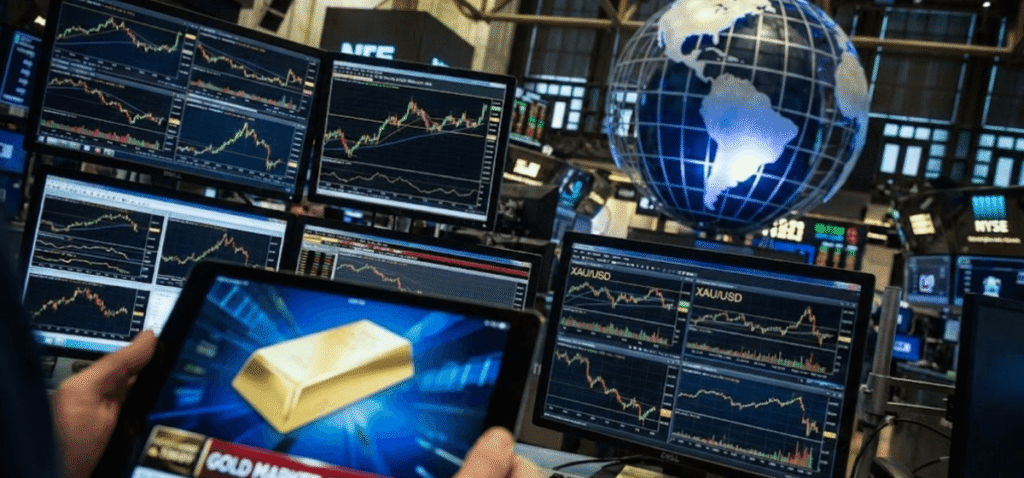
Gold entered 2025 with exceptional momentum, breaking multiple historical levels and attracting record liquidity from central banks, hedge funds, and retail traders. As geopolitical risks rise and global monetary policy shifts toward uncertainty, XAU/USD has become one of the most actively traded assets worldwide, often surpassing major currency pairs in volume.
This report examines what is driving gold’s extraordinary performance, its macroeconomic environment, and the outlook for traders moving into 2026.
Is XAU/USD the new Global Portfolio Anchor
Gold is no longer just a defensive asset— it has become a strategic anchor in global portfolios.


Here are some Key forces behind this shift:
- Global inflation remaining above target
- Central banks diversifying away from U.S. dollar reserves
- Surge in geopolitical tensions across multiple regions
- Growing demand from emerging economies
- Increased retail participation through CFDs
In 2025, gold is acting like both a risk hedge and a trading instrument, delivering high intraday volatility and clean technical structure.
Central Banks Bought Gold at the Fastest Pace in 60 Years
A major catalyst for gold’s rise this year has been unprecedented central-bank accumulation.
Why central banks are buying:
- Reduce reliance on the U.S. dollar
- Currency depreciation risks
- Rebuild national reserves
- Hedge against inflation and global uncertainty
Emerging markets—including China, India, Turkey, and several African economies—have been the most aggressive buyers.
This demand has placed a hard floor under gold prices, limiting deep pullbacks and attracting long-term institutional flows.
Macroeconomic Drivers: What is Moving XAU/USD?
1. U.S. Inflation That Refuses to Cool
Gold’s strongest correlation in 2025 is with U.S. CPI data.
Higher inflation = higher gold demand.
Lower inflation = temporary corrections.
As the Federal Reserve delays rate cuts, gold remains highly sensitive to every data release.
2. Interest-Rate Uncertainty Keeps Traders Active
XAU/USD thrives on uncertainty—and 2025 has plenty:
- Mixed economic indicators
- Conflicting Fed commentary
- Divergence between global central banks
This environment has produced large daily ranges, ideal for day traders and swing traders.
3. Geopolitical Risks at Multi-Year Highs
Gold rallies fast in times of crisis.
Key drivers include:
- Middle East tensions
- Asia-Pacific military posturing
- U.S.–China trade disputes
- Election-related volatility in multiple regions
These events have kept gold in a long-term bullish structure.
4. Weakening Global Currencies Boost Demand
As fiat currencies across Europe, Africa, and Asia face pressure, gold becomes a reliable store of value.
Gold’s inverse relationship with USD has remained intact—but the metal has occasionally rallied alongside a strong dollar due to geopolitical flows.
Technical Outlook: Structure Still Favors the Bulls
Current Technical Snapshot (Dec 2025):
- Price remains above the 200-day moving average
- Higher-high / higher-low structure intact
- Strong demand zones forming near major breakouts
- Institutional order blocks evident on the daily chart
Volatility Profile: Why Traders Love XAU/USD
Gold is now one of the most volatile liquid assets on the market.
Average Daily Range (ADR) in 2025:
150 – 350 pips
Why traders prefer gold:
- Clear reactions to economic data
- Strong technical respect for levels
- High liquidity during London & New York overlap
- Perfect for scalpers, day traders, and swing traders
XAU/USD often moves more in one session than major pairs move in a full week.
Who Is Moving Gold?
1. Hedge Funds & Commodity Trading Advisors (CTAs)
Positioning heavily long due to geopolitical and inflation risks.
2. Central Banks
Providing long-term bullish pressure through structural accumulation.
3. Retail Traders
Using high-volatility CFD platforms globally, especially in Africa and Asia.
4. Algorithmic & High-Frequency Traders
Increasing influence during New York session volatility.
Outlook for 2026
Based on current macroeconomic momentum, three scenarios stand out:
Bullish Scenario (Most Likely):
- Fed delays rate cuts
- Central-bank buying continues
- Geopolitical tensions persist
Neutral Scenario:
- Moderate inflation cooling
- Stable global markets
Bearish Scenario (Low Probability):
- Aggressive Fed rate hikes
- Strong surprise USD rally
Overall, the macro landscape strongly favors continued upside.
Final Thoughts
Whether you’re a macro investor or an intraday trader, XAU/USD is the asset to watch as we approach 2026. Its liquidity, volatility, and alignment with global events make it the most important non-currency trading instrument on the planet today.